The Feed Picks Your Fit: Notes on Logging Off and Getting Dressed
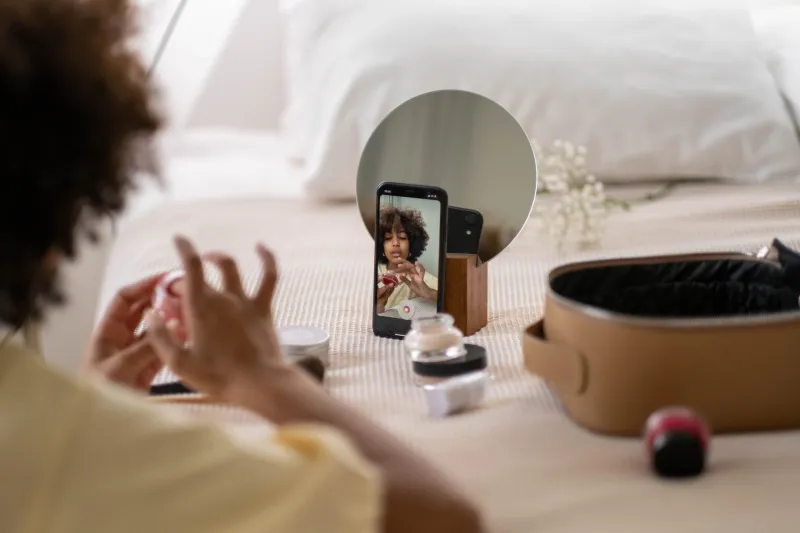
There's a moment every UK teenager knows. You're getting dressed, you've got a vague idea of what you fancy wearing, and then you catch yourself thinking: will this film well? Not — does this feel like me. Not — does this say what I want it to say. Will the camera, the ring light, the fifteen-second clip, approve?
That's not a wardrobe anymore. That's a content pipeline.
The Stylist You Never Hired
The For You page has quietly become the most powerful fashion editor in Britain. It doesn't have an office in Soho. It doesn't have a point of view, exactly — it has a mirror. It watches what you linger on, feeds you more of it, and within three weeks you've bought the cargo trousers, the beanie, the specific shade of washed-out grey that everyone in your scroll is wearing.
And here's the thing that should worry anyone who ever loved streetwear: the algorithm doesn't push the weird stuff. It pushes the median. The statistically safe middle. The fit that 10,000 other people in your demographic already validated with a like. The whole machinery is built on a simple promise — dress like the aggregate and you will be rewarded with visibility.
Visibility is not the same as style. We'd argue it's often the opposite.
The Rebellion Got Optimised
Streetwear was never supposed to be safe. It came from the margins — skaters, crews, kids on estates who wore what they wore because nobody was going to sell it to them in a department store. The whole point was that your fit was a small act of defiance. You dressed against something.
Now the something has a nicer name: engagement. The rebellion got A/B tested. What started as a subculture got funnelled through recommendation engines until 'edgy' became an aesthetic category you can filter by price. Micro-trends rise and die in a fortnight — blokecore one minute, some revived noughties indie sleaze the next — and the kids caught in the middle are just cycling through someone else's mood board at speed.
There's nothing inherently wrong with loving a trend. But when your entire wardrobe is downstream of what a machine decided you'd tolerate, you have to ask: who's actually getting dressed here?
The Off-Grid Dressers
Which brings us to the people this piece is really about. We spent time with a handful of young creatives — a photographer from Sheffield, a duo making zines in Cardiff, a uni student in Glasgow who runs a night wearing, in her words, 'stuff the feed would bury'.
Their common thread isn't a specific look. It's a method. They shop wrong on purpose. Charity shops, army surplus, their dad's wardrobe, fabric from the market and a mate with a sewing machine. They wear things that don't photograph cleanly — clashing textures, silhouettes the trend cycle abandoned, colours that fight each other. One of them told us she deliberately keeps a 'no scroll rule': she doesn't look at outfit content for a month before she makes something new, because otherwise, as she put it, 'I can feel the feed leaking into my hands.'
That phrase stuck with us. The feed leaking into your hands. Because that's exactly what it does. It gets in before you notice, and suddenly your taste isn't yours — it's a smoothed-out average of a thousand strangers.
Going Off-Grid Is the New Punk
We're not romanticising poverty or pretending charity shops are a personality. And look — plenty of brilliant, genuinely subversive style lives on TikTok too. The platform has handed visibility to kids outside London who'd never have got a look in during the gatekept magazine era. That part's real, and it matters.
But the honest version of self-expression in 2025 might be harder than posting. It might mean dressing in a way that doesn't perform. Wearing the fit that gets three likes instead of three thousand. Building a look that exists for the street, the night out, the mate who says 'where did you even get that' — not for the crop.
Every generation gets told its rebellion was co-opted. Ours is stranger: it wasn't stolen, it was optimised. The system didn't ban the weird stuff. It just made the normal stuff so convenient, so endlessly served, that most people never bother looking for anything else.
Defying the norm used to mean shocking your nan. Now it might mean logging off long enough to remember what you actually like — then wearing it, unfiltered, unlisted, for no one's feed but your own.
That's the drop worth queuing for.