Eight-Eye Truth Serum: What Your DMs Have Been Confessing Since 1960
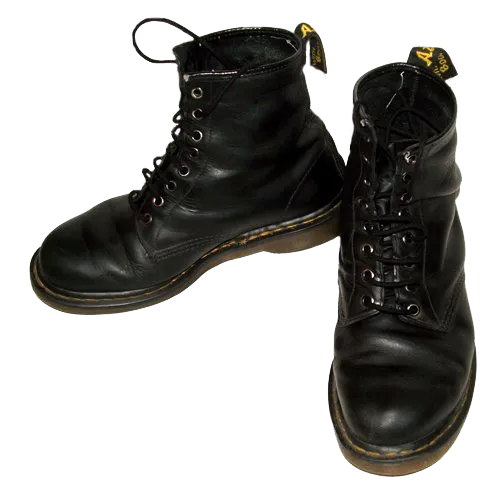
Photo: Doctors_1460_Black_Worn.jpg: IlPasseggero derivative work: Il Passeggero - I love to love you, CC BY-SA 3.0, via Wikimedia Commons
There's a boot on your foot right now, or there was last week, and it's been talking about you behind your back. Not loudly. Doc Martens don't shout. They've never needed to. Sixty-odd years of British history has walked through those yellow stitches, and the 1460 has picked up more stories than most people manage in a lifetime.
Born Broken, Built Stubborn
Start with the origin, because it's more punk than the punks who adopted it. Klaus Märtens was a German army doctor who wrecked his ankle skiing in 1945 and found standard-issue boots about as useful as a chocolate teapot. So he made his own, with air-cushioned soles because his foot hurt. Comfort as rebellion. The boot was literally invented because someone refused to accept what they'd been given.
By 1960 the design had landed on these shores, and the 1460 — named for its launch date, the first of April, which feels right — went straight to work. Postmen. Factory workers. Policemen. People who needed something that wouldn't fall apart by Thursday.
Then the streets got hold of them.
The Boot That Belonged to Everyone and No One
Here's the thing about the DM: it's the most contested garment in British history, and the fights over it were never really about the boot.
Skinheads took it first, in the late sixties — working-class kids, initially a mix of Black and white youth bound by ska and soul, boots cropped short and laces tied tight. A uniform of the estate, of having nowt and making it mean something. Then the decade turned, the scene splintered, and the boot got dragged into uglier territory. For a while in the eighties, a pair of eight-eyes could mean something threatening. People crossed the street.
And then, brilliantly, the boot refused to stay owned.
The two-tone movement and ska revival snatched it back. The Smiths wore them. Morrissey in a gladioli-filled cardigan and DMs is a whole thesis on British identity in one photograph. Grunge arrived and the boot went flat, laces loose, worn with floral dresses by people who'd never seen a building site. By the nineties, the 1460 had been claimed by queers, punks, students, indie kids and anyone else who wanted their footwear to carry an argument.
That's the trick the Doc never lost: it means something different on every foot, and it means something on every foot. There's no neutral version.
Armour You Can Resole
Talk to people about their first pair and the language gets almost embarrassingly sincere. The blister phase is a rite of passage — everyone remembers the weeks of hobbling, the plasters, the question of whether it was worth it. It's a boot that makes you earn it. In a country where we're taught to keep our heads down, a boot that hurts before it works has a certain poetry.
Because that's the real function. Not protection from the rain — let's be honest, they're about as waterproof as a sieve once they've aged. Protection from something else. From being invisible. From being read as someone who didn't choose.
Pride marches. Miner's strike anniversaries. Anti-fascist counter-protests. NHS pay demos. The same boot, marching in opposite directions across the decades, always on the side of whoever decided the world should be different. A fighting boot with a fighting past, worn by people fighting for very different things — and eventually, mostly, by people fighting the good fight.
So What Happens When Your Nan Buys a Pair?
Here's the modern dilemma, and it's a proper one. Walk down any high street from Leeds to Leamington Spa and the eight-eye is everywhere. Worn with mum jeans, worn with dog-walking coats, worn by teenagers who think it's just what you wear and by their grandmothers who very much remember what it used to mean.
Has the boot been defanged? Is this the beige-ification of one of Britain's last genuine symbols?
We'd argue the opposite — cautiously. Yes, the shock value has gone. Your nan in DMs isn't a scandal, and the boot can no longer be used as shorthand for menace the way it once was. But look closer at what replaced the menace: choice. When a garment is adopted by everyone, the meaning shifts from what you are to what you decided. Every person lacing up a 1460 in 2025 is making a small, quiet declaration that they picked this, that it says something about them, even if that something is just 'I walk a lot and I'm not precious.'
The stigma has softened into a signature. And honestly? A signature you can wear to a protest and a job interview in the same week is worth more than one that gets you barred from both.
Wear the Scars
The best DMs are never the ones straight out of the box. They're the ones with the cracked leather, the chewed laces, the sole worn down on one side from how you actually walk. They record you. Your nan's pair has sixty years of someone else in the leather; yours has a decade of festival fields and last-minute trains and that night you can't quite remember.
Britain has always been better at saying things through what it wears than what it says. The Doc Marten is the loudest silence in the national wardrobe — a boot that has meant rebellion, threat, pride, comfort and conformity, sometimes all in the same decade, without ever printing a word on itself.
Keep wearing them. Keep scuffing them. The boot's still listening, and it's still telling everyone exactly who you are.


