No Ring Light Required: The Night Bus Is Britain's Most Honest Front Row
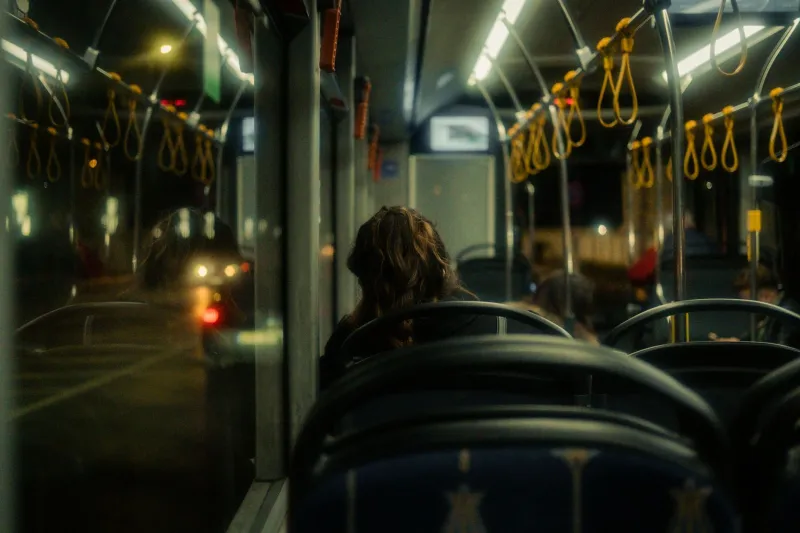
It's 2:14am on a Saturday and the N29 is doing what it does best: refusing to be glamorous. The seats are sticky. The lighting is the colour of an old chip wrapper. Someone is eating a battered sausage with the seriousness of a sommelier. And yet, if you want to see British street style with its defences down, this is the front row.
The after-hours uniform isn't trying to go viral
Nobody plans a night-bus fit the way they plan a grid post. You don't stand in front of a mirror testing angles for a bus shelter on the Holloway Road. You dress for the gap between the last train and the first one back: a coat that can handle a cigarette break, shoes that have already forgiven you, a bag that zips shut because the pavement is not a runway. The result is not chaos. It is editing under pressure.
This is where the real dress codes reveal themselves. Not the ones printed on a club door, but the ones written into the night itself. Warmth. Safety. Pockets. The ability to run for a bus in something that doesn't sound like applause. The after-hours uniform is a negotiation between who you were at 10pm and who you need to be at 4am. It is style with the volume turned down, which is usually when you can actually hear it.
Sodium lights don't flatter. They clarify.
There is no ring light on the top deck. There is a flickering strip light, a window full of closed shops and the occasional phone torch from someone trying to find a lost earring. Under that light, fake tan goes orange, white trainers go grey and a carefully curated outfit either holds up or quietly confesses.
The night bus does not care about your angles. It sees the crease in your shirt where you've been sitting on a wall for an hour. It sees the blister plasters you swore nobody would notice. It sees the way a jacket falls when you're too tired to pose. That is not a flaw in the system. That is the system working. The most honest fit check in Britain happens among strangers who are not looking, not liking and not saving to a mood board.
And there is something freeing in that. When nobody is watching, you stop dressing for the algorithm and start dressing for the actual night. You wear the coat because it's cold, not because it photographs well. You keep the boots on because the alternative is walking home in socks. You let the outfit get a little bit ruined, because the night is already doing that to everyone else.
The kebab shop queue is a better focus group than the group chat
Stand outside any late-night chicken shop and you'll see the same thing: people in outfits that were built for a different plan. A sequin top under a parka. Trackies with a going-out bag. A full face of makeup and the expression of someone who has just realised the night tube isn't running. This is not failure. This is adaptation.
The queue is where the curated version of the night meets the real one. Nobody is asking for your Instagram handle. Nobody is checking whether your trainers match your bag. The only question is whether you're getting chips or a burger, and whether you can find a fiver in a pocket that definitely had one earlier. That is a different kind of style assessment. It is about resourcefulness, not aesthetics. And frankly, it is a better reflection of British street culture than most of what gets posted before midnight.
The night bus is also a class issue in a crop top. Not everyone can summon an Uber when the plan falls apart. Not everyone has a spare room to crash in or a partner with a car. Public transport is the safety net beneath the night out, and the clothes that survive it are the clothes that understand reality. That is not a lesser form of style. It is style with its eyes open.
What we post before midnight vs what survives the last bus
There is a version of the night that exists only on the feed: the perfect lighting, the perfect angle, the perfectly timed story before the club gets too sweaty. It is a performance, and there is nothing wrong with performance. Getting dressed is always a kind of theatre. But the night bus asks a harder question: who are you when the audience has gone home?
That question is at the heart of STIGMA, even if we don't always say it out loud. Wear the label. Defy the norm. But defy it for the bus stop, not just the burn. Defy it for the kebab queue and the last-train platform and the 3am walk from the stop to your front door. Defy it when there is no engagement metric to reward you and no ring light to soften the edges.
The kids who look best at 2am are rarely the ones who looked most polished at 10pm. They are the ones who brought a layer, wore the comfortable shoes, carried the bag that actually closes, and made peace with the fact that the night is not a photoshoot. That is the STIGMA uniform: a bit scuffed, a bit defiant, and entirely yours.
So next time you're standing at a bus stop with a kebab in one hand and your dignity in the other, look around. That's the runway. No front row, no flash, no algorithm. Just sodium lights, sticky floors and a load of people getting dressed for real life. It doesn't ask permission. It never did.