Empty Pockets, Louder Fits: The Kids Turning Nothing Into Everything
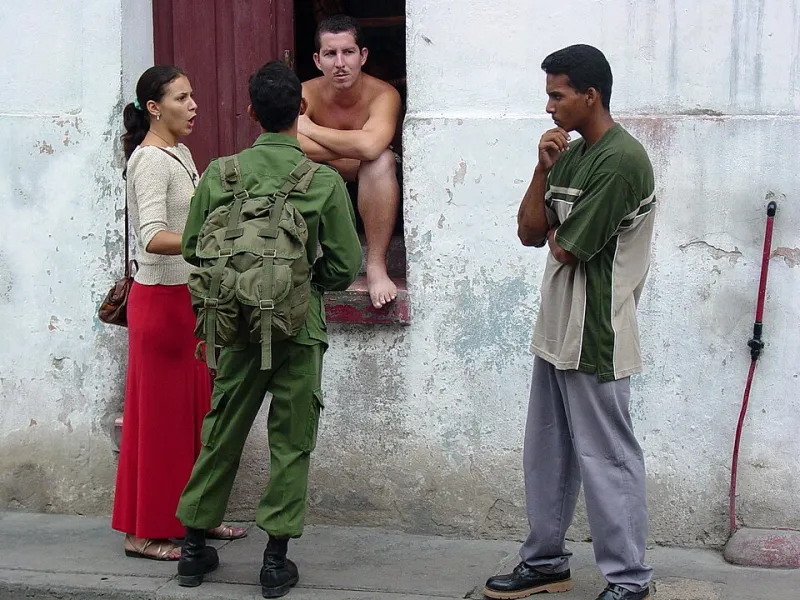
Photo: Adam Jones Adam63, CC BY-SA 3.0, via Wikimedia Commons
There's a myth that floats around every time the cost of living gets a headline: that style costs money. That the best-dressed people in the room have receipts to prove it. Anyone who's ever stood in a Stoke bedroom with £20 and a pair of scissors knows that's rubbish.
The truth is the opposite. Some of the sharpest dressing we've seen this year came from people with the least to spend on it. Necessity doesn't kill creativity — it sharpens it like a blade.
The Hand-Me-Down Economy
Start with the supply chain. Not the drop calendar — the real one. Older siblings' PE kits. A dad's old hi-vis. The hi-vis, actually, deserves its own paragraph: workwear surplus has become the backbone of British street style precisely because it was never meant to be seen. Carhartt didn't get cool because of a campaign. It got cool because lads on sites wore it until it fell apart, and the falling apart was the point.
In Hull, 19-year-old stylist Kayleigh Marsden describes her wardrobe as "basically a jumble sale with intent." Her method: charity shop base layers, a mate's cast-off Nike track bottoms, and one statement piece — usually oversized, usually free — that anchors the whole fit. "If you've got one thing that looks deliberate, everything else reads as a choice," she says. "That's the trick. Intention is free."
That word — intention — comes up again and again. Beige, as we've said before, is a confession. It's what happens when you dress to disappear. The kids we're talking about dress to be seen, and they do it on a budget that would make a marketing department weep.
Stoke: Repping Where You're From
Stoke-on-Trent doesn't get much love on the moodboards. But it's producing some of the most honest dressing in the country. Local stylist and part-time warehouse picker Jordan Tetteh runs a small Instagram page customising surplus workwear — reflective tape, embroidered initials, cut-off sleeves. His materials cost him nothing. His waiting list is three weeks long.
"People assume rebellion means spending," he told us. "But the most rebellious thing you can do in a city like this is look proud of it. Wear the kit. Wear the hand-me-down. Make it look like you chose it, because you did."
There's a long tradition here. Mod, casual, rave — every genuinely British subculture started with people wearing what they had and wearing it better than anyone expected. The dole office wardrobe isn't a new phenomenon. It's the national tradition, finally getting its flowers.
Ladbroke Grove: Heritage Without the Price Tag
Over in West London, the influence runs through carnival and sound system culture — a lineage where style was always about presence, not purchase. Amara Blake, 22, grew up between Ladbroke Grove and Harlesden and describes her approach as "heritage on a budget."
"My mum had a box of clothes from the 90s. That box taught me more than any shop," she says. Vintage shellsuits, football shirts from teams she's got no connection to, a leather jacket older than she is. "Nothing matched and everything worked. That's the West Indian way of dressing — you make the ordinary look like occasion wear."
Amara's rule: never pay full price for anything basic, and never apologise for wearing something twice. "Fast fashion made people embarrassed about repetition. Repeat your fit. Make it yours."
The Politics of the Free Fit
Let's be honest about what's really going on here. When a government tells young people there's no money, and the high street responds by charging £90 for a hoodie, dressing well on nothing becomes an act of defiance. The thrifted fit isn't just economical — it's a refusal to accept that participation in culture requires a credit card.
Every charity shop rail raided before the vintage resellers get there is a small victory. Every dad's old jacket reworked with a patch is a middle finger to the algorithm telling you what to buy.
And there's the deeper point: the stigma attached to second-hand, to hand-me-downs, to visibly not spending — that stigma only works if you agree to feel it. These stylists don't. They wear the provenance like a badge. The scuffs, the frays, the slightly wrong sizes — that's the story, and the story is the fit.
How to Start With Nothing
A few ground rules from the people who know:
- One anchor piece per fit. Everything else supports it. The anchor can be free.
- Learn three alterations. Hem, crop, taper. A sewing kit costs a fiver and beats a £60 alteration bill.
- Raid the family before the shops. The 90s and 2000s are sitting in your parents' loft, unworn.
- Workwear surplus is your friend. Durable, cheap, and it carries a story the high street can't fake.
- Repeat shamelessly. A uniform beats a rotation of forgettable fits.
The bank balance says beige. The wardrobe says otherwise. And honestly? The wardrobe's winning.
Wear the label. Defy the norm. Even if the label is stitched on by hand.